Ordering Information
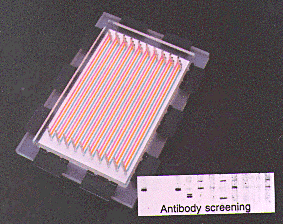
Why cut your blot into strips? The SURF-BLOT can be used for any technique that formerly required cutting the blot into vertical strips. The SURF-BLOT clamps liquid channels tightly onto the surface of a blot. In a typical experiment, antigens are electrophoresed on a flat-topped gel and blotted. The blot is then clamped into the SURF-BLOT and antibody solutions are incubated in the liquid channels. After rinsing, the blot is removed from the SURF-BLOT and the blot visualization step is performed on the intact blot. Since there are no narrow strips to line up, the entire screening set can be compared on the intact blot. The SURF-BLOT is the only slot blot device that has a convex stainless steel backing plate, and has been shown leak-free by the HIV testing lab of the Harvard School of Public Health. Results of this study.
The SURF-BLOT is most commonly used to compare the quality of commercially prepared antibodies, as there is lot of variability from suppliers, and even from different batches from the same supplier. Only about 100 ul of diluted antibody is needed per test compared with 2 to 5 ml needed for strip testing, saving your valuable antibodies. The results are side-by-side, not in separate containers. Another common use of the SURF-BLOT is to optimize blot processing by testing varying ratios of the primary and secondary antibodies. The SURF-BLOT was originally designed to screen monoclonals1 or polyclonals2. The SURF-BLOT 10 and 10.5 are perfect for Grid-Blot screening, a type of antibody screening that does not use a western blot, but rather stripes of target protein bound to a membrane.3,4 The SURF-BLOT has a favorable review in Biocompare by Dr. Campa, whose lab measures the immune response of many patients. From Dr Campa: "Without this device, much of our research would have been dead in the water"6 The resulting U.S. patent application 20120003225 figure 5 display human sera autoantibodies that can be used to detect and treat cancer. The SURF-BLOT allows the immune response of several patients to be measured simultaneously. (see figure 5 below)

Human autoantibodies in response to cancer
Data courtesy of Dr. Michael Campa, Duke University Medical Center

Antibody screening with the Surf-Blot
Other references can be found in the Bibliography.
| Catalog Number | Product Description |
Best For | Number of Channels | Channel Length | Channel Width | Blot Width | Sample Volume | Price (U.S. $) |
|---|---|---|---|---|---|---|---|---|
| 5006 | Surf-Blot 6 | 8 cm. tall minigels | 30 | 6.0 cm. | 1.5 mm. | 8.9 cm. | 60-90 µl | 240.00 |
| 5007 | Surf-Blot 7 | 8 or 10 cm tall minigels | 30 | 7.0 cm. | 1.5 mm. | 8.9 cm. | 70-105 µl | 240.00 | 5009 | Surf-Blot 9 | 10 cm. minigels | 30 | 8.9 cm. | 1.5 mm. | 8.9 cm. | 90-135 µl | 240.00 |
| 5010 | Surf-Blot 10 | Grid-Blot experiments | 30 | 10.1 cm. | 1.5 mm. | 8.9 cm. | 100-150 µl | 240.00 |
| 5013 | Surf-Blot 13 | 15 cm tall gels | 30 | 13.5 cm. | 1.5 mm. | 8.9 cm. | 130-185 µl | 260.00 |
| 5055 | Surf-Blot 5.5 | 8 cm. tall minigels | 21 | 5.5 cm. | 2.5 mm. | 9.3 cm. | 100-140 µl | 240.00 |
| 5075 | Surf-Blot 7.5 | 10 cm. tall minigels | 21 | 7.5 cm. | 2.5 mm. | 9.3 cm. | 100-200 µl | 240.00 |
| 5085 | Surf-Blot 8.5 | Criterion® gels | 33 | 8.5 cm. | 2.5 mm. | 14.7 cm. | 100-220 µl | 240.00 |
| 5105 | Surf-Blot 10.5 | Grid-Blot experiments | 21 | 10.5 cm. | 2.5 mm. | 9.3 cm. | 100-300 µl | 240.00 |
| 5135 | Surf-Blot 13.5 | large format gels | 33 | 13.5 cm. | 2.5 mm. | 14.7 cm. | 100-350 µl | 290.00 |
Criteron is a registered trademark of BioRad Co.
Scientist: I have multiple tissues and am looking at protein expression of five proteins in each tissue using the Surf-Blot. I have antibodies to each of the five proteins. How can I quantitate by western blot the proteins in more than one tissue per gel?
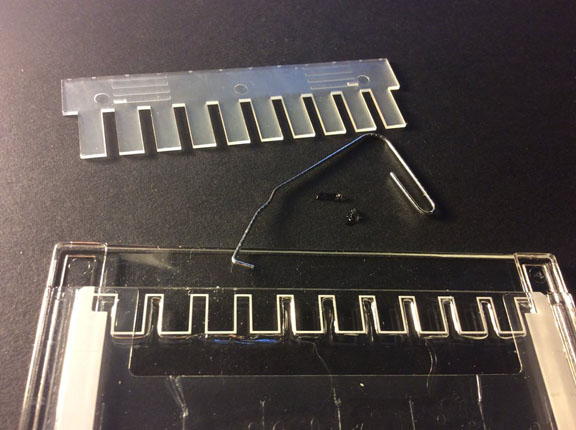
Idea Scientific: If casting your own gels, you could make a three well comb, and examine three tissues per mini gel. Alternatively, we remove the lane dividers from precast 10 well mini gels to make wells of the size we need. We use a bent paper clip to remove the lane dividers from 1mm thick gels. This works best on gels that have a stacking gel. Here is a gel with the acrylamide between lanes 2 and 3, and lanes 3 and 4 removed. That well is large enough to be covered by four 2.5 mm antibody channels, or seven 1.5 mm antibody channels. Each 10 well mini gel gives three of these large wells, and a narrow marker well.